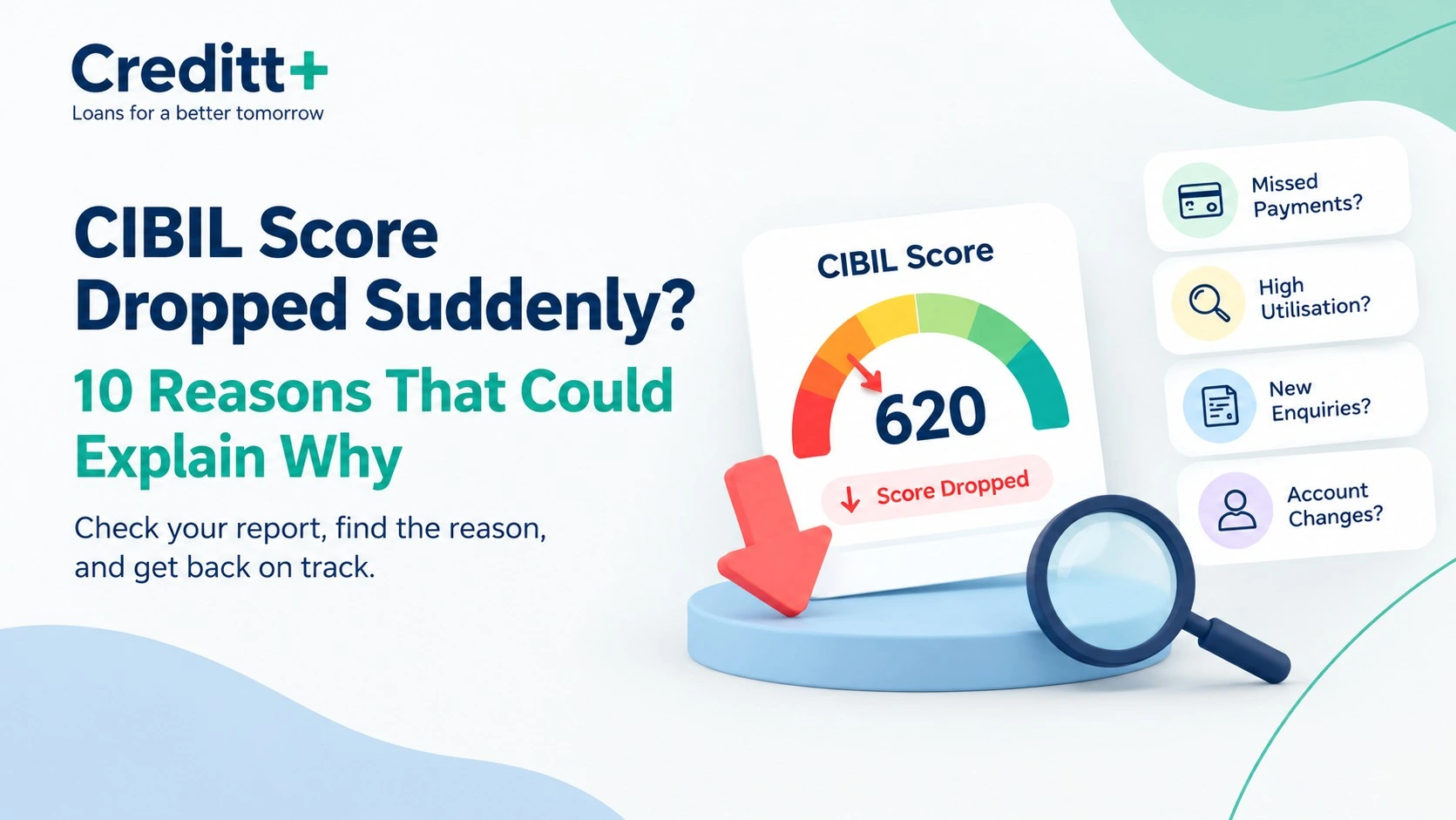

A sudden CIBIL Score drop can be worrying, especially if you are planning to apply for a personal loan. But a lower score does not always mean you missed a payment. Changes in credit utilisation, new enquiries, account activity, repayment history and information reported by lenders can all affect your score.
The best way to find the reason is to check your latest CIBIL Report and compare it with your previous credit activity before making another credit application.
Table of Contents

Why Did My CIBIL Score Drop Suddenly?
Your CIBIL Score is based on information in your credit report. Payment history, credit utilisation, credit history and credit enquiries are some of the factors that can influence it
This means your score can change even when you have not recently missed a payment. A new credit account, higher card balance, account closure or an update from a lender can change the information reflected in your profile.
Before applying for new credit, it helps to understand how CIBIL score is calculated so you can look at the reason behind the change instead of focusing only on the number.
10 Reasons Your CIBIL Score May Have Dropped
Several factors can affect your CIBIL Score, from payment history and credit utilisation to new enquiries, account changes and reporting errors.
1. You Missed or Delayed a Payment
Payment history is one of the key factors affecting your CIBIL Score. A late payment, missed payment or delinquency reported by a lender can negatively affect your credit profile.
Check your recent loan and credit card payments to see whether any instalment or bill was paid after its due date.
Even if the delay was accidental, review the account information in your latest report to confirm what has been reported.
2. Your Credit Card Utilisation Increased
Credit utilisation refers to how much of your available credit you are using. A significant increase in outstanding credit card balances can affect your credit profile.
For example, suppose your total credit limit is ₹1 lakh and your outstanding balance rises substantially from your usual level. The change in utilisation may contribute to a movement in your score.
Did You Know? Credit utilisation is one of the factors CIBIL identifies when explaining how credit scores are calculated. A change in your outstanding card balance can therefore matter even when you have made your payments on time.
3. You Have Multiple Recent Credit Enquiries
When you apply for a loan or credit card, the lender may make an enquiry on your credit report. CIBIL records lender enquiries for loan and credit card applications for the last 36 months.
Several applications within a short period can signal that you are seeking additional credit. This is different from checking your own CIBIL Score.
If you are comparing personal loan options, avoid submitting applications to multiple lenders without first checking the eligibility criteria.
4. You Recently Opened a New Credit Account
Opening a new personal loan or credit card adds another account to your credit history. It can also change your overall outstanding credit and the mix of accounts in your profile.
A new account does not automatically mean your score will fall. Its impact depends on the rest of your credit information and how you manage the account afterwards.
For someone who has never borrowed before, it is also useful to understand how to build your CIBIL score from zero instead of taking on more credit simply to create a score. Creditt+ explains that first-time borrowers can initially have an NA or NH status because there is not enough reported credit history to generate a score
5. You Closed an Older Credit Account
Closing an older credit account can change the structure and age of your credit history.
This does not mean you should keep every credit account open forever. However, consider how closing an older account may affect your overall credit profile before deciding.
It is also useful to understand the range of scores rather than treating 900 as a standard target. The article on whether a 900 credit score is possible explains the CIBIL range and what a very high score represents.
6. Your Outstanding Balances Changed
Your credit report reflects information about your existing credit accounts and outstanding balances. A significant change in these balances can therefore affect the information used to calculate your score.
If you recently repaid a loan, made a large credit card payment or increased your outstanding balance, check whether the updated information is visible in your latest report.
7. An Account Was Reported as Delinquent or Settled
The status of a credit account matters. A normally closed account is different from an account reported as delinquent, settled or written off.
If you see an unexpected status in your report, check the account details carefully. If the information does not match your records, contact the relevant lender and follow the appropriate dispute process.
What Should You Check in Your CIBIL Report?
If your score has changed unexpectedly, your CIBIL Report can help you identify what happened.
Important: Do not judge your credit profile only by the three-digit score. The CIBIL Report provides the account and enquiry details that can help explain why the score changed.
8. Your Lender Updated Information
Credit bureaus receive information from banks and financial institutions. Your CIBIL Report is therefore based on information supplied by these credit institutions.
A lender may update information about an account, payment or outstanding balance, and that updated information can subsequently appear in your credit report.
This is one reason a score change may not always correspond to something you did on the same day.
9. There Is an Error in Your Credit Report
Sometimes the information in a credit report may not match your records.
Look for:
- A loan or credit card you never opened
- An incorrect outstanding balance
- A payment shown as overdue even though you paid it
- An account that should have been closed
- An unfamiliar lender enquiry
CIBIL recommends checking your report for errors and unfamiliar information.
If you identify incorrect information, follow the bureau's process for raising a dispute and contact the relevant lender where necessary.
10. Your Credit Profile Changed Even Without a Missed Payment
A common misconception is that a CIBIL Score can only fall after a missed payment. In reality, CIBIL identifies several factors that influence the score, including payment history, utilisation, credit history and enquiries.
So, if you are asking, "Why did my CIBIL Score drop when I paid everything on time?", check for changes in these areas before assuming something is wrong.
Can a Lower CIBIL Score Affect a Personal Loan Application?
Yes, your CIBIL Score can influence how a lender assesses a personal loan application, but it is not the only factor involved.
For someone researching the CIBIL score for personal loan applications, this distinction is important. A lower score can make borrowing more difficult, but the lending decision can also depend on income, employment, repayment capacity and other eligibility criteria.
This is why two borrowers with similar credit scores may not necessarily receive the same lending decision.
Before applying, checking personal loan eligibility can help you review factors such as income, employment status, credit history and repayment capacity.
What Should You Do After a Sudden CIBIL Score Drop?
Once you notice a change, avoid immediately applying for several new credit products. Start by identifying the reason.
Follow these steps:
- Check your latest CIBIL Report: Look beyond the score and review your accounts and enquiries.
- Review payment history: Check whether any payment has been reported as delayed or overdue.
- Check credit utilisation: Look for a recent increase in credit card balances.
- Review recent enquiries: Confirm that lender enquiries relate to applications you actually made.
- Check account status: Look for unexpected settled, delinquent or closed accounts.
- Identify errors: Compare unfamiliar information with your own financial records.
- Raise a dispute if necessary: Contact the relevant lender and use the appropriate bureau process when information is incorrect.
Tip: If your score has dropped, first understand the reason instead of applying repeatedly for new credit. Fixing an inaccurate report or improving repayment behaviour is more useful than chasing a specific score immediately.
If borrowing is being considered for a genuine short-term requirement, understanding how Short Term Loans work can help you assess the repayment obligation before making a decision.
How Long Does It Take for a CIBIL Score to Improve?
There is no single recovery period that applies to every borrower. The time required depends on why the score changed and what information is subsequently reported by lenders. Someone correcting an inaccurate account may have a different experience from someone rebuilding their credit history after missed payments.
The most useful approach is to maintain consistent repayment behaviour, avoid unnecessary credit applications and regularly review your credit report.
A score is a reflection of your credit history, so meaningful improvement generally comes from maintaining healthy credit behaviour over time.