
A study laptop needs to last through lectures, assignments, research, presentations, and countless browser tabs without becoming frustrating to use. That makes choosing the right budget just as important as choosing the right laptop.
Many students worry about spending too much and paying for features they'll never use, while spending too little can lead to performance issues that become noticeable within a year or two. With so many choices available, it's easy to focus on what others are buying rather than what your own studies actually require.
The goal is to find a laptop that can comfortably handle assignments, research, online classes, and project work without stretching your budget unnecessarily. For most academic needs, ₹25,000 sits in a practical middle ground between affordability and long-term usability.
Table of Contents

What ₹25,000 actually buys you in a study laptop in 2026
At ₹25,000 in 2026, you can buy a laptop that handles real study work smoothly. Focus on the parts that affect daily use, not the brand on the lid.
The specs that matter for studying vs the specs you can skip
Spend on the parts that shape daily use, and save on the parts your course will never touch.
- Specs that matter: memory and storage first, since 8GB RAM keeps notes, tabs, and a video class running together, and an SSD loads everything fast.
- Specs you can skip: for non-design courses, skip dedicated graphics and top clock speeds, because a current-gen entry processor and a Full HD screen are enough.
When studying actually needs more than ₹25,000
Some courses genuinely need more power, and it helps to know which ones. Engineering students running CAD software, design and film students editing video, and data-science students training models will all push past what a ₹25,000 laptop can handle.
If your course lives in those tools, budgeting ₹35,000 or more is the rational choice, not an indulgence. For every other field, the extra spend mostly buys speed you will rarely notice in daily coursework.
Should a student stretch the budget, or buy what the course needs?
Match your laptop budget to your course, not to what your classmates carry. Before you stretch it, ask one thing: will the extra money solve a problem your course actually creates? If yes, the spend is worth it. If you are only matching a friend's machine or chasing a newer look, stop there. A laptop earns its price by doing your coursework well.
Cost-per-year of a study laptop
A laptop's price feels heavy as a single number, but that changes once you spread it across the years you will use it.
- ₹25,000 over a three-year degree works out to a little over ₹8,000 a year
- That breaks down to under ₹700 a month
Judged as a monthly cost rather than a one-time bill, a study laptop is an easy expense to absorb, and the sticker price is no reason to settle for less.
Why buying too cheap costs more
Going too cheap is a false economy. A sub-₹20,000 laptop usually ships with 4GB of RAM and slower storage, and it starts struggling with everyday multitasking within a year.
Many students who buy at that level end up replacing the machine halfway through their degree, which means paying twice. Spending a little more once, on 8GB and an SSD, is cheaper than buying a weak laptop now and a second one later
How students without a credit history can finance a laptop
No credit history yet? Don't worry you still have three clear ways to fund a study laptop: your own savings, family support, and an education-purpose short-term loan for those who already earn.
- Use your savings: Setting money aside over a term costs nothing extra and leaves you with no repayment. Best when your current laptop still works and the new one can wait.
- Get family support: For a full-time student with no income, a parent or guardian buying or contributing is the most practical route, and many families treat a study laptop as a shared education expense.
- Take a short-term loan: Open to working students and salaried recent graduates who earn, a short-term personal loan for education expenses covers the gap when you need the laptop now, and some lenders consider first-time borrowers without a credit history.
Financing without prior credit history
You do not always need a past loan record to be considered for credit. On Creditt+, a prior credit history is not a hard requirement for first-time borrowers, and eligibility is assessed on your wider profile instead.
Most lenders look for a score of around 680 as the usual credit score requirement for personal loans in India, yet first-time borrowers are judged on income and profile rather than past loans alone.
Saving over a term vs financing the purchase now
Saving up has no cost, but waiting has one too when the laptop is needed for the current semester, since missed submissions, classes on a borrowed device, and falling behind on coursework all carry an academic cost that is hard to recover.
- If the laptop can wait a term: saving wins, because you avoid any repayment and the delay costs you nothing.
- If your current semester depends on it: buying now protects your grades more than the wait would ever save you.
What a short-term loan for a ₹25,000 laptop looks like in practice
Financing a ₹25,000 laptop this way is simple, because ₹25,000 sits inside the ₹8,000 to ₹35,000 range these loans cover. With Creditt+, it runs in four steps:
Step 1: Apply
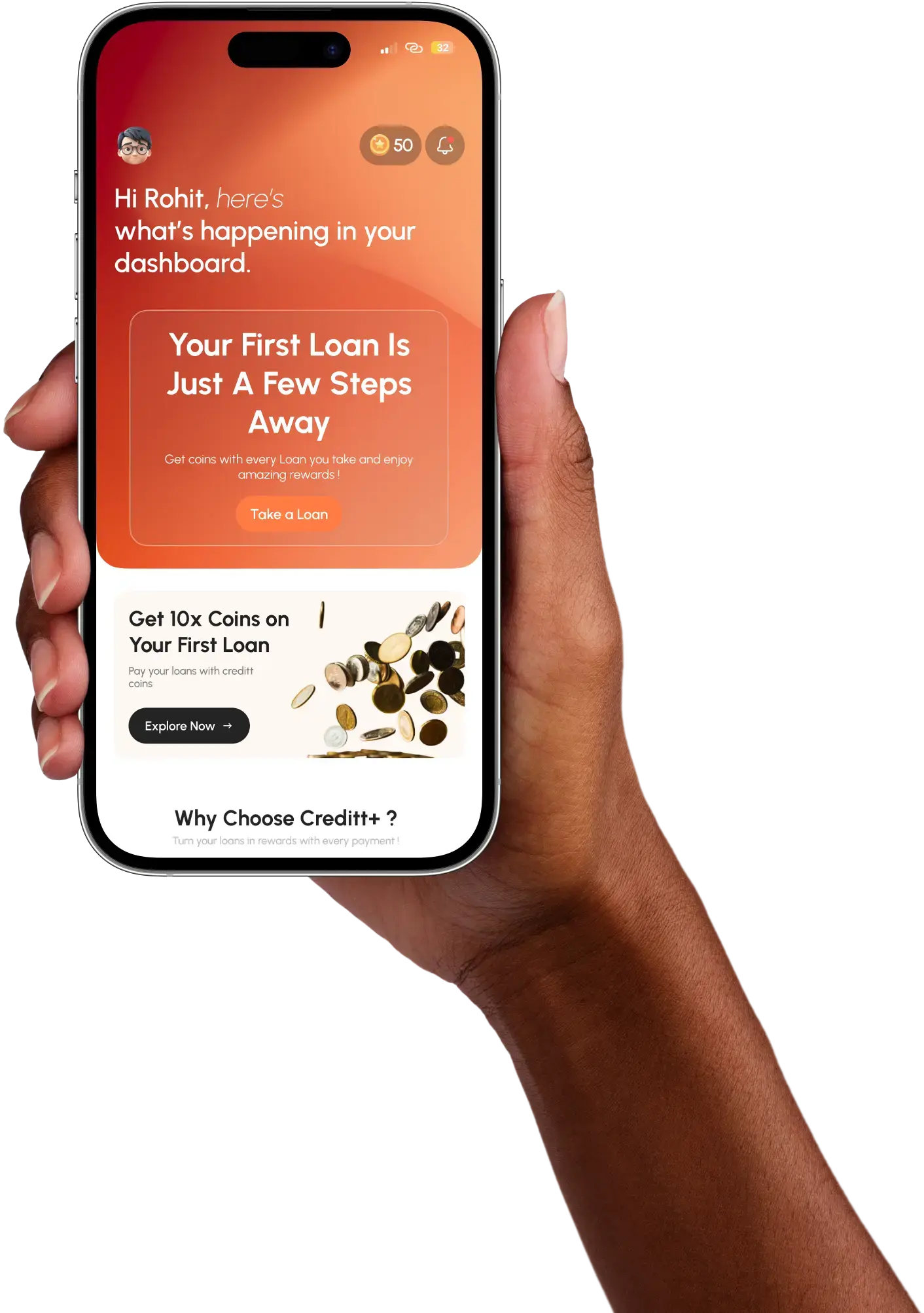
Open the app or website and complete a quick e-KYC and a selfie, with no document uploads.
Step 2: Approval
Eligibility is checked on your salary, age, and profile, so it is decided case by case.
Step 3: Disbursal
Once approved, the funds reach your bank account in a few minutes.
Step 4: Repayment
You repay one fixed amount across a single cycle with a clear end date, and the loan closes.
Lending is in partnership with Sampati Securities Ltd, an NBFC registered with the RBI under number 01.00214, so approval is never guaranteed in advance.
The repayment math for a student or recent graduate
Run one quick check before you borrow, Monthly take-home minus fixed monthly expenses = your surplus. That surplus across the repayment cycle should comfortably cover the loan.
A ₹12,000 monthly surplus covers a ₹25,000 laptop loan across the across a short term repayment cycle without touching your essentials. If your surplus is thinner than this, save toward part of the cost first and borrow less.
A ₹12,000 monthly surplus allows the student to build up savings during the repayment cycle. Over the course of the cycle, this accumulated surplus can comfortably cover a ₹25,000 laptop loan without affecting essential expenses.
Types of Budgeting Methods Observed
For most students, ₹25,000 is a practical laptop budget because it balances performance and affordability. Before making the purchase, think about which of these categories you fall into:
Every student's financial situation is different. Whether you are buying a budget laptop or a higher-spec device, it helps to decide how you will fund the purchase before committing to it. The following budgeting methods are commonly used by students and recent graduates:
- Using savings for part of the cost: You already have some money set aside and only need to cover the remaining amount.
- Keeping savings available for other expenses: You can afford the laptop but prefer to keep cash free for rent, transport, exam fees, or emergencies.
- Buying a second-hand or refurbished laptop: You prioritise value and lower upfront costs over owning a brand-new device.
Whichever approach you choose, the goal is the same: get a laptop that can comfortably support your coursework without creating unnecessary financial pressure. If the laptop is needed immediately, eligible working students and recent graduates can apply through the Creditt+ app or website and complete the process digitally.